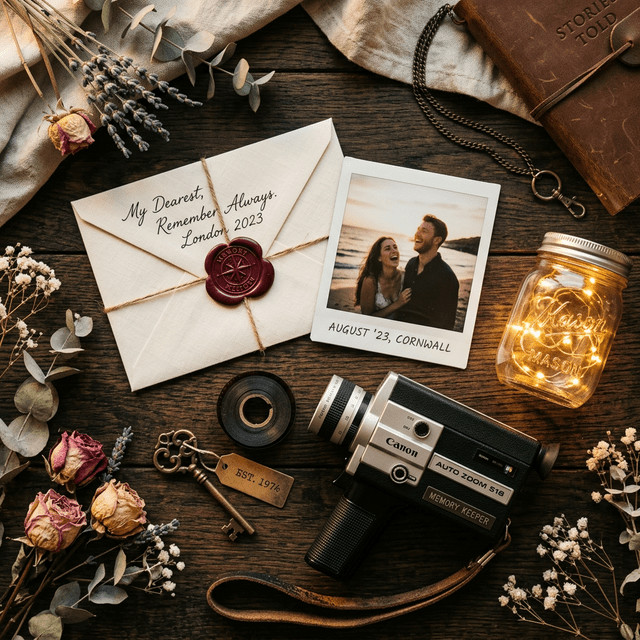
You have 14,000 photos on your phone. Maybe more. You haven’t looked at most of them since the day you took them.
You’ve got backups on iCloud, Google Photos, maybe a hard drive somewhere. You feel safe. Your memories are preserved.
Except they’re not. Not really.
The Photo Paradox
Here’s something nobody talks about: photos preserve moments, but they don’t preserve memories.
A photo of your birthday dinner shows who was there, what you were wearing, and where you were sitting. It doesn’t show what it felt like. It doesn’t capture the joke your dad told that made everyone choke on their wine. It doesn’t preserve the argument that happened in the car on the way there, or the quiet conversation that happened after everyone left.
A photo is evidence. A memory is experience. And your camera roll is full of evidence with no context.
The “I’ll Remember” Lie
You take a photo because you think: “I’ll remember this.” You won’t.
Open your phone. Scroll back to photos from 3 years ago. Pick one at random. What was happening that day? What were you feeling? What happened the hour before that photo? The hour after?
If you’re like most people, you can’t answer. The photo triggers a vague sense of familiarity — “oh yeah, that was that trip” — but the actual memory, the lived experience, the texture of the moment? Gone.
Photos are thumbnails of your life. But you’re not living in thumbnails.
What Actually Preserves a Memory
Neuroscience tells us that the strongest, most retrievable memories are multi-sensory: they involve sound, emotion, context, and personal narrative. A photo is visual only. It’s one dimension of a multi-dimensional experience.
Here’s what preserves memories with actual depth:
Voice
Your voice carries emotional weight that text and photos can’t match. The way you pause before saying something vulnerable. The way you speed up when you’re excited. The slight crack when you talk about someone you miss.
Your voice is a fingerprint of your emotional state. And unlike a face in a photo, a voice transports you back to the exact feeling you had when you spoke.
Context and Story
A photo of a sunset is nice. A 60-second recording of you saying, “We drove two hours to see this sunset because Sarah’s been having a rough week and I thought it might help, and honestly, looking at this, I think it did” — that’s a memory.
Context turns a moment into a story. And stories are how humans actually store and retrieve meaning.
The Stuff Around the Edges
The things that matter most are almost never in the frame:
- The music playing in the background
- The temperature of the room
- What you were worried about that week
- The conversation that happened right before the photo
- The feeling in your chest when you looked at the person next to you
None of this shows up in your camera roll. All of it shows up in a video recording where you talk to camera for two minutes.
The Camera Roll Problem Goes Deeper
It’s not just that photos are incomplete. There’s a more insidious issue: having too many photos makes each one less valuable.
When you have 14,000 photos, none of them feel special. They blur together. You stop looking at them. Your “memories” become a database — perfectly organized, never accessed.
The act of scrolling through hundreds of photos doesn’t feel like remembering. It feels like inventory.
Contrast that with finding a single video of yourself from five years ago. You watch it and you’re immediately transported. You hear your voice. You see your face. You notice the poster behind you that you forgot about, the haircut you’d totally forgotten, the laugh you didn’t know had changed.
One video does more than a thousand photos because it’s dense with information, context, and emotion.
What You Should Do Instead
I’m not saying stop taking photos. Take all the photos you want.
But once a month — or whenever something significant happens — sit down for two minutes and record yourself talking to camera.
Don’t perform. Don’t filter. Just talk.
Say what happened today. What you’re feeling. Who mattered to you this week. What you’re worried about. The funny thing that happened at lunch. The decision you’re about to make.
Then seal it. Don’t put it in your camera roll where it’ll get buried between screenshots and food pics. Use a platform like EchoeBack that time-locks it. Send it to yourself six months from now, or a year, or five years.
When it arrives, you won’t just see a photo of your life. You’ll hear it. You’ll feel it. You’ll meet a version of yourself that you’d already started to forget.
The Most Valuable Recording You’ll Ever Make
Somewhere in your phone right now, there’s a video of your kid’s school play, or your friend’s birthday toast, or a sunset you filmed on vacation.
Those videos aren’t the most valuable ones you could make. The most valuable recording is the one where you sit down, look at the camera, and say:
“Here’s what my life actually looks like right now.”
Nobody else can make that recording for you. And future-you needs it more than you think.
Your photos tell people what you looked like. Your videos tell people who you were.
Record a 2-minute capsule today →
EchoeBack is a digital time capsule platform for video and text messages. Preserve the memories that photos can’t. Learn more.